


Oysters are an eco-friendly protein choice that actively improves ocean health. Each oyster filters up to 50 gallons of water daily, removing pollutants and excess nutrients. They also create reefs that support marine life - up to 50 times more biodiversity than barren sea floors. Unlike other farming, oyster farming requires no feed, fertilizers, or freshwater, making it a low-impact and regenerative practice. Plus, their shells store carbon, contributing to long-term carbon capture. By eating oysters, you're supporting cleaner waters, healthier ecosystems, and local farming communities.
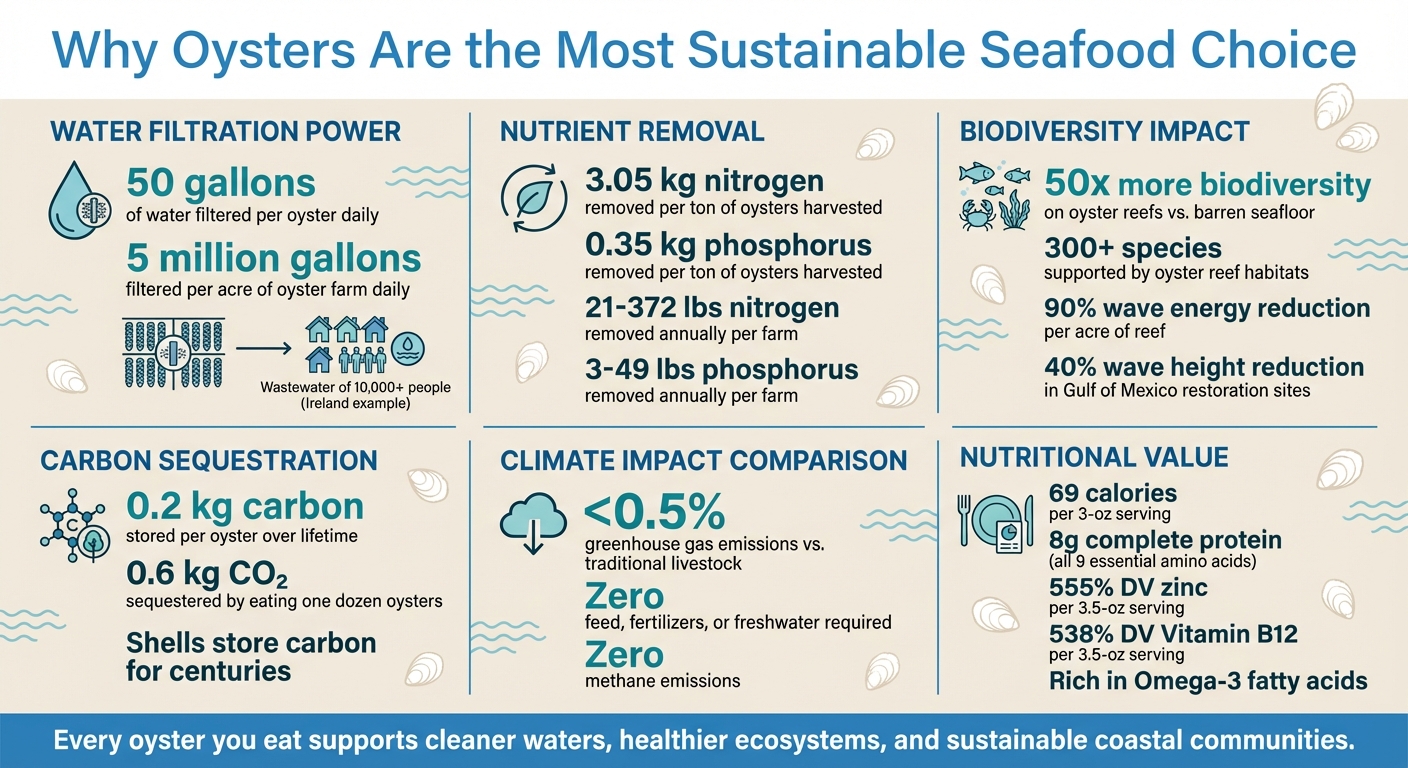
Environmental Benefits of Oyster Farming: Key Statistics
Sustainability In Oyster Farming
sbb-itb-5051793
The Problem: Ocean Health Under Threat
Our oceans are grappling with a crisis that's often hidden from plain sight. Years of human activities have pushed marine ecosystems to their limits, endangering the intricate systems that sustain countless species. Let’s dive into how excess nutrients and habitat destruction are jeopardizing marine life.
Water Pollution and Excess Nutrients
One major issue stems from fertilizer runoff. Over the years, the use of fertilizers has skyrocketed, doubling the amount of nitrogen available to living organisms on Earth. When it rains, these nutrients are washed off farms, lawns, and urban areas, eventually making their way into coastal waters. In Florida alone, more than 300 miles of the state’s 1,539 miles of coastal waters now exceed the recommended nitrogen levels set by the state.
This surplus nitrogen, along with phosphorus, triggers massive algal blooms in a phenomenon called eutrophication. These blooms prevent sunlight from reaching underwater plants like seagrass. When the algae die, their decomposition uses up oxygen in the water, creating "dead zones" where fish and other marine life struggle to survive.
Loss of Marine Species and Habitats
Pollution and coastal development have also taken a toll on vital marine habitats. Structures like oyster reefs and seagrass beds, which act as nurseries for young fish such as striped bass and black sea bass, are disappearing.
Without these habitats, the marine food web faces serious disruptions. For example, healthy oyster reefs can support far more marine life than barren sea floors. However, overharvesting and coastal development have reduced these natural filters, weakening the ecosystem's ability to clean the water. This loss also leaves coastlines more prone to erosion, adding yet another layer of vulnerability.
How Oysters Help the Environment
Oysters play a big role in improving ocean ecosystems. They naturally filter water, create habitats, and grow efficiently - all without requiring outside resources.
Oysters Filter and Clean Water Naturally
Think of each oyster as a tiny water treatment plant. They filter algae, organic matter, pollutants, and sediment, releasing cleaner water back into the ecosystem. An acre of oyster reef can process millions of gallons of water daily, removing excess nutrients that often lead to harmful algal blooms.
Take Ireland, for example: the Pacific oyster industry there removes nitrogen comparable to the wastewater produced by over 10,000 people every year. Harvesting just one ton of oysters eliminates an average of 3.05 kg of nitrogen and 0.35 kg of phosphorus from coastal waters. These nutrients, if left unchecked, can create dead zones and fuel algal blooms.
Chesapeake Bay restoration efforts show just how effective oysters can be. As oyster populations grow, water clarity improves, allowing sunlight to reach seagrasses. These seagrasses provide essential nursery spaces for fish. Additionally, oyster biodeposits foster bacteria that convert reactive nitrogen into harmless nitrogen gas.
But oysters don’t just clean water - they also reshape their surroundings by building habitats teeming with life.
Oyster Reefs Create Habitats for Marine Life
Oyster reefs are bustling ecosystems, offering shelter and resources for a variety of marine species. Their complex structures, filled with crevices and vertical surfaces, attract marine life that can’t thrive on flat, muddy seabeds. In fact, vibrant oyster reefs can support up to 50 times more marine life than nearby sandy or muddy areas.
These reefs are home to over 300 species, including mussels, barnacles, blue crabs, striped bass, and flounder. Juvenile fish find refuge here, safely growing until they’re ready to swim in open waters. Restoration projects, like those led by the NOAA Chesapeake Bay Office, are tracking improvements in oyster density and biodiversity using sonar surveys across 10 tributaries.
Oyster reefs also act as natural barriers, absorbing wave energy and protecting coastlines. A single acre of reef can reduce wave energy by up to 90%. In the Gulf of Mexico, restored reefs have cut wave heights by 40%, helping safeguard coastal areas and wetlands from erosion and storm surges.
On top of these benefits, oysters are incredibly resource-efficient to farm.
Oyster Farming Requires Minimal Resources
Oyster farming is about as low-maintenance as it gets. Oysters feed by filtering the water around them - no need for feed, fertilizers, or chemicals. They thrive in saltwater, meaning they don’t require freshwater or land.
Compare that to traditional fish farming, which relies on large amounts of feed and often pollutes local waters. Or livestock farming, which demands land, freshwater, and grain while producing significant greenhouse gas emissions. Oysters, by contrast, actively improve water quality.
"Oyster farming is a unique example of aquaculture that benefits the ecosystem. Oyster farms provide habitat, improve water quality, and contribute to marine health."
– Dr. Sylvia Earle, Environmental Scientist
Oysters also contribute to carbon sequestration. As they grow, they build calcium carbonate shells, which lock away carbon for centuries. Over its lifetime, a single oyster can store up to 0.2 kg of carbon. Eating a dozen oysters indirectly supports the sequestration of around 0.6 kg of CO₂. Since farmed oysters are regularly replenished, their environmental benefits continue indefinitely, making oyster farming a regenerative practice in every sense.
How Little Wicomico Oyster Co. Farms Oysters Responsibly
Eco-Friendly Farming in Virginia's Little Wicomico River
The Cockrell family has been farming oysters in Virginia's Little Wicomico River since 1930. With four generations of experience, they’ve developed methods that protect the local ecosystem while producing high-quality oysters.
The farm maintains low-density stocking levels - about 100,000 oysters per acre - using rafts or bags. This approach promotes water flow and prevents sediment buildup, keeping nutrient cycles intact without significantly altering nitrogen or phosphorus levels. By avoiding overcrowding, they also reduce the risk of self-pollution caused by oyster waste.
To ensure optimal conditions, the team monitors water quality with sensors and occasional manual tests, carefully timing harvests to maximize flavor. Impressively, oysters on the farm filter up to 5 million gallons of water per acre each day.
"By following eco-friendly oyster farming methods, we keep our environmental impact low to support the ecosystem and protect the oyster population."
– Kristen Cockrell, Little Wicomico Oyster Co.
Their methods go beyond stocking density. The farm avoids machinery that disturbs the seabed, using removable structures to prevent silt buildup and maintain natural tidal patterns. This safeguards the river's benthic macrofauna - organisms living on the riverbed. Furthermore, oysters are hand-reared and harvested at low tide, ensuring they stay undamaged while preserving the health of the beds. Each harvest helps improve water quality, removing 21–372 lbs of nitrogen and 3–49 lbs of phosphorus annually. This nutrient removal reduces algal blooms and prevents oxygen depletion in the river.
These thoughtful practices not only protect the environment but also support the production of premium oysters.
Premium Oyster Varieties Farmed Responsibly
The farm’s Blackberry® Reserve Oysters are a testament to their commitment to both sustainability and quality. These oysters are raised over 18–24 months in low-density conditions, allowing them to filter the water naturally while developing their distinct briny, full-bodied flavor. Grown in bottom cages near the Blackberry Hang Oyster Reef, they reach a harvest size of 3–5 inches.
Harvest timing is carefully managed to avoid interfering with spawning cycles, and spat selection is done with care to prevent the introduction of invasive species. These efforts ensure the long-term productivity of the oyster beds. Additionally, the oyster reefs foster marine biodiversity by creating habitats for fish and other species, all without harming the seafloor.
"Our family has hauled a living from the same watershed for four generations. For this reason, we care fiercely about protecting it."
– Little Wicomico Oyster Co.
Customers have noticed the farm’s dedication to sustainability. Blackberry® Oysters boast a 4.8/5-star rating from 221 reviews, while Blackberry® Reserve Oysters have an impressive 5/5-star rating from 133 reviews. For those wanting a closer look at their sustainable practices, the farm offers educational tours at their oyster nursery in Ophelia, VA, led by Dr. Lynton Land. These tours give visitors a firsthand understanding of responsible oyster farming.
Why Choosing Oysters Supports Better Eating Habits
How Eating Oysters Benefits the Environment
When it comes to low-impact food choices, oysters are hard to beat. Unlike livestock such as beef, pork, or poultry, oyster farming produces minimal greenhouse gases. It generates almost no carbon dioxide or nitrous oxide and absolutely no methane. In fact, the emissions from oyster farming are less than 0.5% of those produced by traditional livestock farming.
Oysters also play a crucial role in cleaning the environment. Each oyster can filter up to 50 gallons of water every single day. This process removes pollutants and excess nutrients that can cause harmful algal blooms. On top of that, their calcium carbonate shells store carbon for hundreds of years.
"By choosing oysters on your plate, you're essentially voting for cleaner waters and healthier coastal ecosystems." - Kiera Jefferson, Author
Nutritionally, oysters are a powerhouse. A 3-ounce serving contains just 69 calories but delivers 8 grams of complete protein, including all nine essential amino acids. They are also packed with nutrients: a 3.5-ounce serving provides 555% of the Daily Value for zinc and 538% for Vitamin B12, along with heart-healthy Omega-3 fatty acids - all without the saturated fats found in red meat.
The environmental benefits grow even stronger when you support local, family-owned oyster farms.
Supporting Local, Family-Owned Oyster Farms
Locally farmed oysters do more than just offer a sustainable food option - they also strengthen regional ecosystems and communities. These farmers use low-impact methods that not only produce high-quality oysters but also improve the health of coastal waters. Research led by Professor Raymond Grizzle at the University of New Hampshire in 2024 found that farmed Eastern oysters at six different sites effectively removed nitrogen and carbon from estuaries. This type of farming helps combat coastal eutrophication and boosts water quality.
"Oyster farming presents a valuable strategy for nutrient management in estuarine ecosystems, particularly in mitigating coastal eutrophication." - Raymond Grizzle, Research Professor of Biological Sciences, University of New Hampshire
When you choose oysters from operations like Little Wicomico Oyster Co., you’re supporting a family-owned business that prioritizes sustainable practices. These farms protect local waters, create jobs, and contribute to the resilience of Virginia's coastal communities. By enjoying sustainably farmed oysters, you’re not just making a healthy dietary choice - you’re also helping to preserve ecosystems and strengthen local economies.
Conclusion
Oysters stand out as one of the most eco-friendly food choices. Each oyster can filter up to 50 gallons of water daily, store carbon in their shells for centuries, and provide habitats for over 300 marine species - all without needing feed, fertilizers, or freshwater to grow. Compared to traditional livestock farming, oyster farming generates less than 0.5% of greenhouse gas emissions while actively improving coastal water quality.
By choosing Little Wicomico Oyster Co., you're supporting sustainable practices that safeguard Virginia's Little Wicomico River and uplift coastal communities. These family-run farms use regenerative methods that benefit marine ecosystems.
"Eating oysters is more than a culinary experience - it's an act of environmental stewardship." - Kiera Jefferson, Author
With every oyster, you're not just enjoying a nutrient-packed delicacy; you're contributing to cleaner waters and thriving shorelines. Supporting oyster farming helps build a sustainable food system while promoting healthier oceans.
FAQs
Are oysters safe to eat if they filter polluted water?
Oysters are not safe to eat if they come from polluted water. These shellfish act as natural filters, meaning they can absorb harmful contaminants like bacteria, viruses, and toxins from their surroundings. Eating oysters from such environments can pose serious health risks. To stay safe, always make sure your oysters are sourced from clean, regulated waters.
How can I tell if oysters were farmed sustainably?
Sustainably farmed oysters can be recognized by checking if they come from farms that emphasize eco-friendly methods. These practices typically focus on enhancing water quality, preserving marine habitats, and using minimal resources, such as feed. By choosing sustainably farmed oysters, you're not just enjoying a tasty treat but also supporting efforts to restore ecosystems and minimize environmental impact - an excellent option for those who care about the planet.
What’s the best way to store and serve oysters at home?
To keep oysters fresh, store them in the refrigerator at a temperature between 33–40°F. Use a breathable container, such as a mesh bag or a shallow tray, to allow proper air circulation and prevent water from accumulating. Never immerse oysters in fresh water, as this can harm them.
When it’s time to serve, arrange the oysters cupped side down on a chilled tray. For the best flavor and safety, aim to eat them within 24 hours of storage, especially if they are still alive.

